Understanding the climate patterns of the Nile Valley and surrounding deserts is vital when scheduling a holiday. Whether you are exploring ancient temples or sailing downriver, choosing the right seasonal window ensures maximum comfort and cultural immersion.
Winter Season (December – February): The Peak Exploration Window
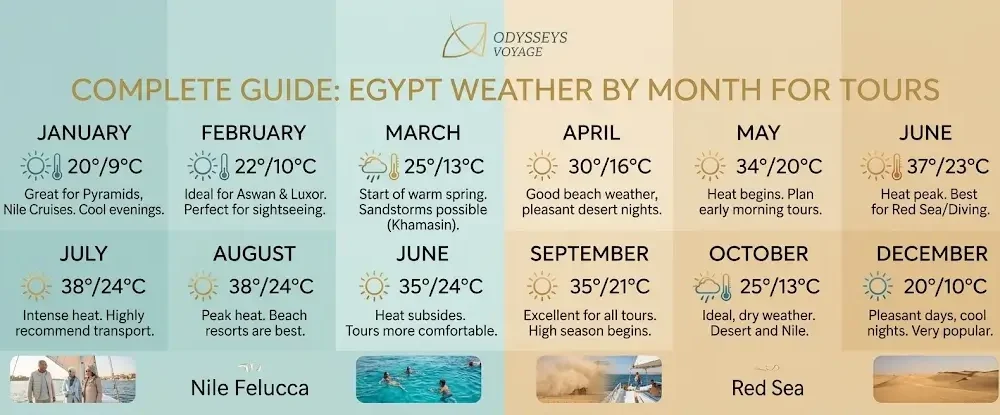
Winter delivers crisp, clear skies and mild daytime temperatures across Upper and Lower Egypt. It represents the most popular timeframe for comprehensive sightseeing across ancient necropolises and temple complexes.
-
December: Daytime temperatures hover around 20°C–23°C (68°F–73°F). Ideal conditions for walking tours through the Valley of the Kings and Karnak Temple.
-
January: The coolest month of the year (18°C–21°C / 64°F–70°F). Evenings along the Nile can drop below 10°C (50°F), requiring warm layers for deck lounging.
-
February: Temperatures begin to climb gently (21°C–24°C / 70°F–75°F), with extended daylight hours perfect for navigating the Nile River.
For travelers seeking curated historical journeys, explore our flagship Egypt Travel Packages and signature Egypt Nile Cruises.
Spring Season (March – May): Blooming Landscapes & Desert Warmth
Spring brings warmer afternoons and blooming desert vegetation. It offers a well-balanced climate before peak summer heat sets in.
-
March: Mild and pleasant (24°C–27°C / 75°F–81°F). Excellent for combined desert expeditions and river navigation.
-
April: Warm days averaging 28°C–31°C (82°F–88°F). Exceptional conditions for private yacht charters and extended sailing.
-
May: Transition into summer temperatures (32°C–36°C / 90°F–97°F). Site visits are best scheduled during morning hours.
Discover our boutique sailing options:
Summer Season (June – August): Serene Waters & Uncrowded Sites
Summer brings intense sunshine, with midday temperatures exceeding 38°C–42°C (100°F–108°F) in Luxor and Aswan.
-
June: Long sunny days with dry heat; monuments are exceptionally quiet during morning and late afternoon windows.
-
July: High summer temperatures. Sightseeing takes place early at sunrise, followed by river relaxation.
-
August: Sustained warmth, best suited for leisurely river journeys and Red Sea snorkeling excursions.
Autumn Season (September – November): The Classic Sailing Months
Autumn marks the return of optimal weather across all regions. The cooling desert breeze creates ideal conditions for small-ship sailing.
-
September: Cooling trend begins (32°C–34°C / 90°F–93°F), with fewer tourists at major archaeological sites.
-
October: The quintessential travel month (28°C–30°C / 82°F–86°F), offering perfect conditions for outdoor temple exploration.
-
November: Crisp autumn days (24°C–26°C / 75°F–79°F), offering optimal conditions for long journeys and multi-country routes.
Plan ahead with our extended itineraries:
Dahabiya Size & Authentic Nile Navigation
When most travelers hear the word Dahabiya, they imagine a graceful sailing boat drifting silently along the Nile, powered only by the wind. While that image reflects the original purpose of a traditional Dahabiya, not every boat marketed as a Dahabiya offers the same experience.
At Odysseys Voyage, we believe the size of a Dahabiya makes all the difference.
A Traditional Dahabiya is Designed to Sail
For centuries, Dahabiyas were built with elegant proportions that allowed them to harness the Nile’s natural winds. Their carefully balanced size enables them to glide peacefully under sail, creating the quiet and authentic journey that has made these boats so special throughout Egyptian history.
When the wind fills the sails, the only sounds you’ll hear are the breeze, birds along the riverbanks, and the gentle movement of the Nile. This is the experience that inspired our Dahabiya journeys.
Why Size Matters
Many modern Dahabiyas have been built much larger to accommodate more cabins and more guests. While they may still be called Dahabiyas, their size changes the experience completely.
A larger Dahabiya is simply too heavy to be propelled by the Nile’s wind alone. Instead of sailing, it is pulled throughout the journey by a separate tugboat. The sails may be raised for appearance, but they are not what moves the vessel.
A traditional-sized Dahabiya, on the other hand, is carefully designed to harness the wind and offer genuine sailing whenever conditions allow—just as Dahabiyas have done for generations.
Access to Hidden Nile Gems
Another major advantage of a traditionally sized Dahabiya is where it can go. Because of its smaller dimensions, it can:
-
Anchor beside peaceful Nile islands.
-
Visit small traditional villages.
-
Stop at quiet riverbanks far from the crowds.
-
Offer walks through authentic local communities.
-
Reach places that larger vessels simply cannot access.
These intimate stops are often the highlight of the journey, allowing guests to experience everyday life along the Nile rather than only the major tourist attractions.
Designed for Authenticity, Not Capacity
Our Dahabiya was carefully designed to preserve the character of traditional Nile sailing. Rather than maximizing the number of cabins, we chose a size that allows the boat to:
-
Sail naturally with the Nile’s winds whenever conditions allow.
-
Navigate comfortably through narrower sections of the river.
-
Reach secluded islands and authentic villages.
-
Offer a peaceful boutique atmosphere with fewer guests on board.
Exclusive Dahabiya Sailing: October 17th – 21st, 2026
Experience the Nile the way it was meant to be — slow, peaceful, and away from the crowds aboard our elegant Dahabiya.
-
Route: 4 Nights from Luxor to Aswan
-
Departure: October 17th – 21st, 2026
-
Inclusions: Full board, private Egyptologist guide, skip-the-line monument entries, and private transfers.
-
Focus: Ideal for couples, solo travelers, and small groups seeking crowd-free historic travel.
Explore additional special itineraries:
Special Offer: 15% Off Egypt Nile Cruises 2026
Planning ahead ensures access to premium river cabins and private guides. Odysseys Voyage is offering an exclusive 15% discount on select Egypt Nile Cruises 2026 bookings.
As one of the premier luxury tour operators for Egypt and Jordan, our custom journeys combine private transport, scholarly Egyptologist guidance, and small-ship navigation along the river.
Combined Egypt & Jordan Expeditions
Cross-border journeys allow travelers to pair the Pyramids of Giza and the Nile Valley with the rose-red city of Petra and the desert expanses of Wadi Rum.
The Epic Heritage: From Homer’s Odyssey to Egyptian Antiquity
The ancient Mediterranean world was intricately connected through trade, seafaring, and shared mythology. Homer’s epic narrative, The Odyssey, reflects the maritime spirit that defined the ancient eastern Mediterranean, where Bronze Age sailors navigated coastal currents linking Greece, the Levant, and the Nile Delta.
Our brand, Odysseys Voyage, draws direct inspiration from this timeless heritage of meaningful exploration. Rather than rushed transit, our boutique Dahabiya voyages and cross-border expeditions echo the authentic journeys of ancient travelers—embracing historical depth, authentic hospitality, and slow exploration along the Nile.
FAQ
What is the best month to visit Egypt for comfortable sightseeing?
October through April is considered the optimal timeframe. Daytime temperatures range from 18°C to 28°C (64°F to 82°F), providing mild conditions for walking through open-air archaeological complexes in Luxor, Aswan, and Cairo.
How does weather impact Nile Dahabiya sailing?
Dahabiyas rely on natural river winds and currents. The autumn and spring months provide stable breezes for authentic sail-powered navigation, while winter offers cool, pleasant days along the water.
What should travelers pack for winter in Egypt?
While winter days are sunny and mild, desert and river temperatures drop noticeably after sunset. Layered clothing, a medium jacket, and comfortable walking shoes are recommended for evening deck relaxation and early morning temple excursions.
Can Egypt and Jordan tours be taken year-round?
Yes, though the spring (March to May) and autumn (September to November) seasons offer balanced, temperate conditions across both the Nile Valley and the high-desert landscapes of Petra and Wadi Rum.
Are summer Nile cruises recommended?
Summer travel allows for a quiet, crowd-free experience at major monuments. Excursions are scheduled during the early morning hours, leaving afternoons free for relaxing in air-conditioned suites or shaded river decks.
Don’t just take our word for it; read what our satisfied travelers have to say about their experiences with Odysseys Voyage.
Read Our Reviews