
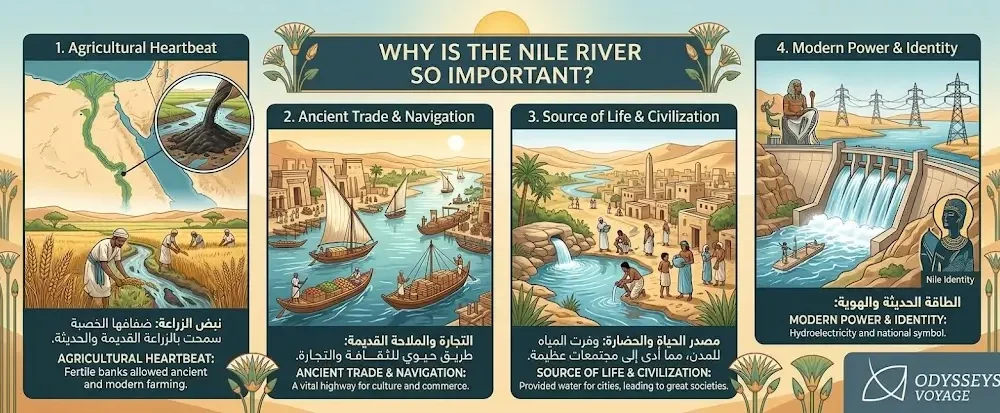
The question of why is the Nile River so important sits at the heart of human civilization, global history, and modern African ecology. Without this 6,650-kilometer river, ancient civilization could never have survived the hyper-arid Sahara Desert.
Understanding why is the Nile River so important requires looking at how water, agriculture, faith, and trade intersected to forge one of humanity’s greatest cultural legacies. Today, travelers and historians alike ask why is the Nile River so important when exploring ancient dynasties or embarking on tranquil sailing routes across upper Egypt.
As recognized specialists and widely regarded as among the best tour companies for Egypt and Jordan, Odysseys Voyage crafts curated journeys revealing the cultural and geographical vitality of this waterway.
Discovering why is the Nile River so important helps modern travelers appreciate how every temple, obelisk, and village owes its existence to the majestic river.
What Made the Nile River Vital to Civilization?
The Miracle of Annual Flooding (Akhet)
Ancient Egyptian agriculture depended entirely on the river’s annual flood, known as Akhet. Each summer, monsoon rains in the Ethiopian Highlands forced the Blue Nile to swell, sending nutrient-dense volcanic silt down into the arid Nile Valley.
Farmers cultivated emmer wheat, barley, flax, and legumes in this rich black mud, producing bountiful harvests that shielded populations from famine and produced grain surpluses capable of feeding tens of thousands of temple and pyramid artisans.
Essential Fresh Water and Hydrological Balance
Passing through thousands of miles of arid desert, the Nile River remains the only permanent source of freshwater for millions of inhabitants. It established an oasis corridor where human, animal, and plant life could thrive safely away from desert winds.
[Rainfall in Ethiopian Highlands] ➔ [River Swells with Basaltic Silt] ➔ [Natural Inundation of Egypt] ➔ [Agricultural Surplus] ➔ [Monumental Dynastic Civilization]
Papyrus, Flora, and Fauna
The marshlands of the Nile produced papyrus reeds, which revolutionized record-keeping, administration, mathematics, and literature throughout antiquity.
Furthermore, the river supported teeming fish populations, waterfowl, and wildlife that underpinned the daily diet and religious symbolism of dynastic Egypt.
Why Is the Nile River So Important Historically and Culturally?
The Backbone of Trade, Transport, and Governance
The river served as the natural superhighway of antiquity. With prevailing winds blowing south and the current flowing north, sailing vessels could effortlessly traverse the entire length of Egypt.
-
Stone Transportation: Massive limestone and granite blocks quarried in Aswan were transported downstream directly to Giza, Luxor, and Memphis.
-
Unified Governance: Pharaohs projected military power, dispatched scribes, and collected revenue efficiently because of direct waterway connectivity.
-
Cultural Cohesion: Shared religious festivals, languages, and artistic styles unified populations stretching from the First Cataract to the Mediterranean Delta.
Sacred Symbolism and Egyptian Cosmology
To the ancient Egyptians, the Nile was divine manifestation, embodied by the deity Hapi, god of fertility and the flood. The eastern bank symbolized birth and life where towns flourished, while the western bank, where the sun set, became the realm of eternity, housing royal tombs, pyramids, and the Valley of the Kings.
+-------------------+---------------------------------------------------+
| Cultural Dimension| Historical Impact Along the Nile River            |
+-------------------+---------------------------------------------------+
| Agriculture       | Yielded three seasonal farming cycles based on    |
|                   | flooding (Akhet), planting (Peret), harvest (Shemu)|
| Architecture      | Allowed transport of multi-ton monolithic stones  |
| Religion & Myths  | Inspired Osiris-Isis mythology and funerary texts  |
| Regional Trade    | Connected Nubia, Sudan, and Levant trade routes   |
+-------------------+---------------------------------------------------+
How Modern Travelers Experience the River’s Legacy
Experiencing why is the Nile River so important requires slow, immersive travel far away from crowded tourist motorcoaches. Modern historical exploration highlights the contrast between the fertile riverbanks and the stark desert cliffs.
To understand why is the Nile River so important from a historical perspective, travelers board traditional wooden sailing ships that mirror the ancient barques of the pharaohs:
-
Exploring isolated archeological sites like Gebel el-Silsila, accessible only by boutique vessels.
-
Visiting monumental centers including Karnak, Luxor Temple, Kom Ombo, and Philae.
-
Walking through rural farming villages whose agricultural rhythms remain unchanged for millennia.
Discover Authentic Sailing with Odysseys Voyage
For travelers seeking unmatched authenticity, chartering a vessel provides total privacy and flexibility. Consider reserving a Private Dahabiya Charter to experience the Nile with personal Egyptologists and custom sailing schedules.
Featured Dahabiya & Egypt Packages:
-
Comprehensive Egypt Nile Cruises & Egypt Dahabiya Collection
-
Educational Students Tour Packages & Egypt Travel Packages
Exclusive Offer: Egypt Nile Cruises 2026 – Save 15%
Planning your bucket-list expedition in advance delivers exceptional benefits. As the Best Egypt Tours Travel Agency, Odysseys Voyage is proud to launch an exclusive promotion for the 2026 travel season:
Limited-Time Promotion: Receive an immediate 15% discount on all Egypt Nile Cruises 2026 bookings when you reserve your package early.
Whether you select an intimate sailing on an authentic Dahabiya or combine your Nile discovery with Jordan’s Nabataean wonders, this 15% discount ensures luxury travel at unmatched value.
Seamless Multi-Country Expeditions: Egypt and Jordan Packages
Experience the dual heritage of the Nile Valley and the Hashemite Kingdom of Jordan with specialized dual itineraries:
-
Specialized Spiritual Journeys & Restorative Healing Journeys
Spotlight: Exclusive Dahabiya Nile Cruise (October 2026)
Exclusive Dahabiya Nile Cruise – Limited Availability!
-
Duration: 4 Nights from Luxor to Aswan
-
Departure Date: October 17th – 21st, 2026
-
Vessel: Aboard Our Elegant Dahabiya — An Intimate Nile Journey
Experience the Nile the way it was meant to be — slow, peaceful, and away from the crowds. Sail with a small group and discover hidden gems along the river.
What’s Included:
-
4 nights aboard our traditional Dahabiya
-
Full board (breakfast, lunch, dinner prepared by our private onboard chef)
-
Private Egyptologist guide (English, German, or French)
-
All entry tickets (skip-the-line access to temples and heritage sites)
-
Comfortable air-conditioned transfers during all excursions
Ideal for couples, small groups, or solo travelers seeking a unique, crowd-free Nile experience.
Limited cabins available — early booking recommended.
Curated Thematic Expeditions & Future Solar Phenomena
Odysseys Voyage designs niche journeys for discerning travelers seeking specialized historical, astronomical, or spiritual expeditions:
-
Solar Eclipse Dahabiya Nile Cruise Tour 2027 (witness the total solar eclipse over the Valley of the Kings)
-
Exclusive group savings via our Group Travel Special Offers
Common Mistakes Travelers Make When Visiting the Nile
-
Choosing Crowded Floating Hotels Over Traditional Dahabiyas: Large motor ships carry hundreds of passengers and cannot dock at secluded historic islands or ancient quarries like Gebel el-Silsila.
-
Underestimating River Distances and Timing: Attempting to rush between Cairo, Luxor, and Aswan by bus causes exhaustion; river sailing integrates relaxation with sightseeing.
-
Skipping Egypt & Jordan Combinations: Many visitors visit Egypt without realizing that Petra, the Dead Sea, and Wadi Rum are easily connected via direct flights from Cairo or Amman.
-
Booking Without Expert Egyptologist Guidance: The hieroglyphs and architectural phases along the Nile require certified scholarly interpretation to be appreciated.
FAQ
Why is the Nile River so important to Egypt’s survival?
The Nile River provides over 90% of Egypt’s freshwater supply for drinking, municipal use, and agricultural irrigation. Without the perennial flow of the river through the Sahara Desert, Egypt would be an uninhabitable desert wasteland.
Why is the Nile River so important for modern international tourism?
The Nile River connects the world’s densest concentration of ancient monuments, including Luxor, Karnak, Edfu, Kom Ombo, and Philae. Cruising the river offers tourists a seamless, peaceful mode of travel between upper Egypt’s archaeological sites.
What is the difference between a large cruise ship and a Dahabiya?
A Dahabiya is an authentic, twin-masted sailing boat carrying only 8 to 18 guests, offering personal service, peaceful sailing, and access to shallow-water heritage sites that large 150-passenger cruise ships cannot approach.
When is the ideal season to cruise the Nile River?
The peak travel window runs from October through April, when daytime temperatures are pleasant and nights are cool, making temple exploration throughout Upper Egypt comfortable.
Can travelers combine an Egypt Nile cruise with Jordan?
Yes, multi-country journeys seamlessly link Cairo and a Nile cruise with flight connections to Amman, allowing travelers to tour Petra, Wadi Rum, and the Dead Sea under a single coordinated itinerary.