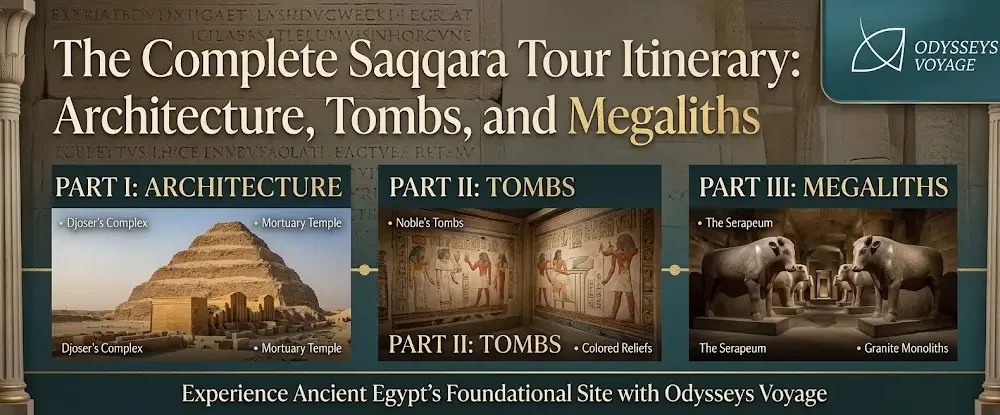
Designing an effective Saqqara tour itinerary requires understanding Egypt’s evolution of monumental stone architecture. Saqqara served as the primary necropolis for the ancient capital of Memphis for over three thousand years.
A dedicated Saqqara tour itinerary allows travelers to witness the architectural transition from rectangular mud-brick mastabas to soaring stone pyramids.
Booking a guided Saqqara tour itinerary ensures seamless access to newly opened tombs, subterranean complexes, and active excavation sectors.
       [ Cairo / Giza Departure ]
                   │
                   ▼
     [ Step Pyramid of Djoser Complex ]
        - Dry Moat & Enclosure Wall
        - Subterranean Galleries & Shaft
                   │
                   ▼
    [ Pyramids of Unas & Teti (Pyramid Texts) ]
                   │
                   ▼
       [ Mastaba Tombs of Ti & Mereruka ]
                   │
                   ▼
         [ The Underground Serapeum ]
                   │
                   ▼
     [ South to Dahshur or Nile Dahabiya ]
1. Step Pyramid Complex of King Djoser
Every comprehensive Saqqara tour itinerary starts at the Step Pyramid of Djoser, engineered by the master architect Imhotep during the Third Dynasty (c. 2670 BCE). This landmark represents the world’s first large-scale cut-stone construction.
-
The Hypostyle Colonnade: A grand entrance hall consisting of 40 limestone columns attached to masonry walls, imitating bundled reed architecture.
-
The Great South Court: A massive ceremonial courtyard featuring curved boundary markers used during the King’s Heb-Sed jubilee run.
-
The Central Step Pyramid: Rising six tiers to a height of 62.5 meters, housing a central burial shaft descending 28 meters into granite chambers.
2. The Subterranean Wonders: The Serapeum of Saqqara
A specialized Saqqara tour itinerary must include the Serapeum, a subterranean burial complex dedicated to the sacred Apis Bulls.
-
Located in the desert plateau, this rock-cut labyrinth contains 24 colossal, monolithic black granite and diorite sarcophagi weighing up to 70 tons each.
-
The precision of the stonework inside the vaults continues to draw international interest from engineers, historians, and travelers.
3. Old Kingdom Mastabas and Pyramid Texts
Beyond pyramids, a private Saqqara tour itinerary reveals the artistic achievements of Old Kingdom nobles:
-
The Pyramid of Unas: The earliest known royal structure inscribed with the Pyramid Texts—magical and religious spells carved in green hieroglyphic pigments to guide the Pharaoh through the afterlife.
-
The Mastaba of Ti: A Fifth Dynasty tomb offering relief carvings depicting daily life, agricultural tasks, cattle crossings, and boat-building along ancient river canals.
-
The Tomb of Mereruka: A massive 33-room mastaba complex containing vibrant wall reliefs displaying fishing expeditions, tax collections, and Old Kingdom judicial procedures.
Curated Full-Day Saqqara Tour Itinerary Options
Choosing the right Saqqara tour itinerary depends on your travel pace, physical mobility, and depth of archaeological interest.
| Time Allocation | Tour Focus | Key Archaeological Sites | Recommended Traveler Type |
| Half-Day (4 Hours) | Essential Saqqara Tour Itinerary | Djoser Step Pyramid, South Court, Pyramid of Unas | Fast-paced, time-sensitive travelers |
| Full-Day (7 Hours) | Complete Saqqara Tour Itinerary | Step Pyramid, Serapeum, Mastaba of Ti, Imhotep Museum | History enthusiasts & photography lovers |
| Combined Day (8 Hours) | Cairo Necropolis Circuit | Saqqara, Dahshur (Bent & Red Pyramids), Memphis City | Travelers seeking full pyramid evolution context |
To customize your daily schedule, explore our private travel programs:
-
Discover personalized travel arrangements through our Tailor-Made Experiences.
-
Explore diverse itineraries with our comprehensive Egypt Travel Packages.
-
Review specialized options designed for educational groups via Students Tour Packages.
From Saqqara to the Nile: Why the Size of a Dahabiya Matters
After completing your Saqqara tour itinerary in Lower Egypt, continuing your journey south to Upper Egypt via the Nile offers the ultimate cultural immersion. However, the choice of vessel defines the quality of that experience.
When most travelers imagine a Dahabiya, they picture a graceful sailing vessel drifting silently along the river, powered only by the wind. While that image reflects traditional river travel, not every boat marketed as a Dahabiya provides that authenticity.
+-------------------------------------------------------------------------+
|                  DAHABIYA EXPEDITION COMPARISON                         |
+-------------------------------------------------------------------------+
|  TRADITIONAL SAILING DAHABIYA          OVERSIZED MOTORIZED VESSEL       |
|  - Wind-powered & silent               - Pulled constantly by tugboat   |
|  - Direct access to shallow islands    - Restricted to industrial docks |
|  - Small-group boutique setting        - High-density passenger volumes |
|  - Authentic village walk stops        - Standard commercial routes     |
+-------------------------------------------------------------------------+
A Traditional Dahabiya is Designed to Sail
For centuries, Dahabiyas were constructed with balanced proportions that allowed them to harness the Nile’s natural winds. Their size allows them to glide peacefully under sail.
When the wind fills the sails, mechanical noise disappears, leaving only the breeze, birds along the riverbanks, and the movement of the water.
Why Size Matters: The Tugboat Reality
Many modern operators build oversized vessels to accommodate more passenger cabins. A larger Dahabiya is too heavy to be propelled by wind alone.
Instead of genuine sailing, it is pulled throughout the entire voyage by an active tugboat. The sails may be unfurled for photographs, but they do not power the vessel. A traditionally sized Dahabiya harnesses the wind for authentic sailing whenever river conditions permit.
Access to Hidden Nile Gems
A traditional Dahabiya’s compact draft and maneuverability open access to exclusive river regions:
-
Mooring beside quiet, uninhabited Nile islands.
-
Visiting traditional agricultural villages inaccessible to large motor cruisers.
-
Docking at peaceful riverbanks far from standard commercial crowds.
-
Engaging in authentic walks through local riverside communities.
Odysseys Voyage maintains a dedicated fleet of traditional vessels designed for authenticity, quiet navigation, and boutique hospitality.
-
Book a Private Dahabiya Charter for exclusive private groups.
-
Reserve the classic 4 Nights Dahabiya Cruise from Luxor to Aswan.
-
Embark on the 6 Days / 5 Nights Luxury Dahabiya Journey.
-
Enjoy the downriver 6 Nights Dahabiya Cruise from Aswan to Luxor.
-
Sail on the 8-Day Dahabiya Journey Through Ancient Egypt.
-
Discover deeper history with the 10-Day Nile Dahabiya Experience or the 12-Day Adventure and Luxurious Dahabiya Cruise.
-
Browse full river categories through Egypt Nile Cruises and Egypt Dahabiya Fleet.
Special Departure: Exclusive Dahabiya Nile Cruise (October 2026)
Experience the Nile the way it was meant to be—slow, peaceful, and away from crowds. Secure your cabin on our small-group sailing expedition:
-
Route: 4 Nights from Luxor to Aswan
-
Dates: October 17th – October 21st, 2026
-
Inclusions: 4 nights aboard our traditional Dahabiya, full board (breakfast, lunch, dinner), private Egyptologist guide (English, German, or French), skip-the-line monument entries, and private land transfers.
-
Suitability: Ideal for couples, solo travelers, and small groups seeking a peaceful sailing journey.
Take advantage of our 15% discount on 2026 Egypt Nile Cruises and combined regional tours by reserving your voyage early.
Connecting Ancient Horizons: The Odyssey, Egypt, and Mediterranean History
The fascination with epic voyages stretches back to antiquity. Homer’s The Odyssey—adapted into Christopher Nolan’s 2026 cinematic epic starring Matt Damon as Odysseus—captures humanity’s enduring desire to navigate uncharted horizons.
Historically, ancient Greece and Bronze Age Egypt were closely linked across the Mediterranean. Homer referenced Egypt’s wealth and medicine in The Odyssey, noting that the island of Pharos stood off the Egyptian coast long before Alexandria was founded.
At Odysseys Voyage, our brand name honors this spirit of cultural exploration. We craft journeys that connect major historical milestones across the Mediterranean and Middle East, bridging ancient mythology, pharaonic legacy, and world heritage.
Best Tour Companies for Egypt and Jordan: Multi-Country Programs
Combining a Cairo and Saqqara tour itinerary with an expedition across Jordan delivers an extraordinary Middle Eastern journey. As a leading tour operator for regional packages, Odysseys Voyage manages cross-border travel logistics between Egypt and the Hashemite Kingdom of Jordan.
       [ Cairo & Saqqara Tour Itinerary ]
                     │
                     ▼
      [ Luxor to Aswan Dahabiya Cruise ]
                     │
                     ▼
             [ Flight to Amman ]
                     │
                     ▼
        [ Jerash Roman Decapolis Ruins ]
                     │
                     ▼
    [ Petra: The Rose-Red Nabataean City ]
                     │
                     ▼
     [ Wadi Rum Desert & Dead Sea Respite ]
Curated Multi-Country Itineraries
-
Comprehensive Routes: Experience the Nile & Desert Kingdoms: Egypt and Jordan or the Deserts & Dynasties Adventure.
-
Cultural Immersions: Reserve the Ancient Wonders & Living Cultures Tour or our classic Timeless Egypt & Jordan Itinerary.
-
Spiritual Journeys: Discover sacred regional sites with the Sacred Lands Spiritual Journey, or browse our dedicated Spiritual Journeys and Healing Journeys packages.
-
Special Interest Expeditions: Explore ancient astronomy via the Solar Eclipse Dahabiya Nile Cruise Tour 2027, book the Ancients Sailing on the Nile Tour, or check our Group Travel Special Offers.
-
Explore all options via our Egypt & Jordan Packages Directory.
Common Mistakes When Planning a Saqqara Tour Itinerary
-
Allocating Insufficient Time: Attempting to explore Saqqara in under two hours misses the Serapeum and interior mastaba reliefs.
-
Skipping Dahshur and Memphis: Visiting Saqqara without stopping at the nearby Red and Bent Pyramids of Dahshur leaves out a crucial chapter in pyramid engineering.
-
Omitting Qualified Egyptologists: Navigating hieroglyphic texts and architectural nuances without an expert guide diminishes the educational value of the site.
-
Neglecting Sun Protection: Saqqara’s desert plateau offers limited shade; plan for early morning visits, hats, and ample hydration.
FAQ
What is the best time of day to begin a Saqqara tour itinerary?
Starting your Saqqara tour itinerary between 7:30 AM and 8:30 AM allows you to explore the Step Pyramid of Djoser and open mastabas before peak temperatures and tour bus arrivals.
Can you go inside the Step Pyramid during a Saqqara tour itinerary?
Yes, visitors can access the interior shafts and restored granite vaults of the Djoser Step Pyramid by purchasing an additional interior entry ticket alongside standard necropolis admission.
How far is Saqqara from central Cairo or Giza?
Saqqara is located approximately 30 kilometers (18 miles) south of central Cairo. Travel time by private air-conditioned vehicle ranges from 45 to 60 minutes depending on morning traffic.
Why choose a private Dahabiya over a large Nile cruise ship?
A traditional Dahabiya relies on wind power for silent, peaceful sailing and carries fewer passengers. Its smaller size allows it to dock at private river islands and quiet villages that large cruise liners cannot navigate.
What is included in an Odysseys Voyage Egypt & Jordan tour package?
Our cross-border packages include luxury hotel accommodations, boutique Dahabiya river cruises, private Egyptologist and local Jordanian guides, private transfers, domestic flights, and skip-the-line entrance fees to all scheduled sites.
Don’t just take our word for it; read what our satisfied travelers have to say about their experiences with Odysseys Voyage.
Read Our Reviews